
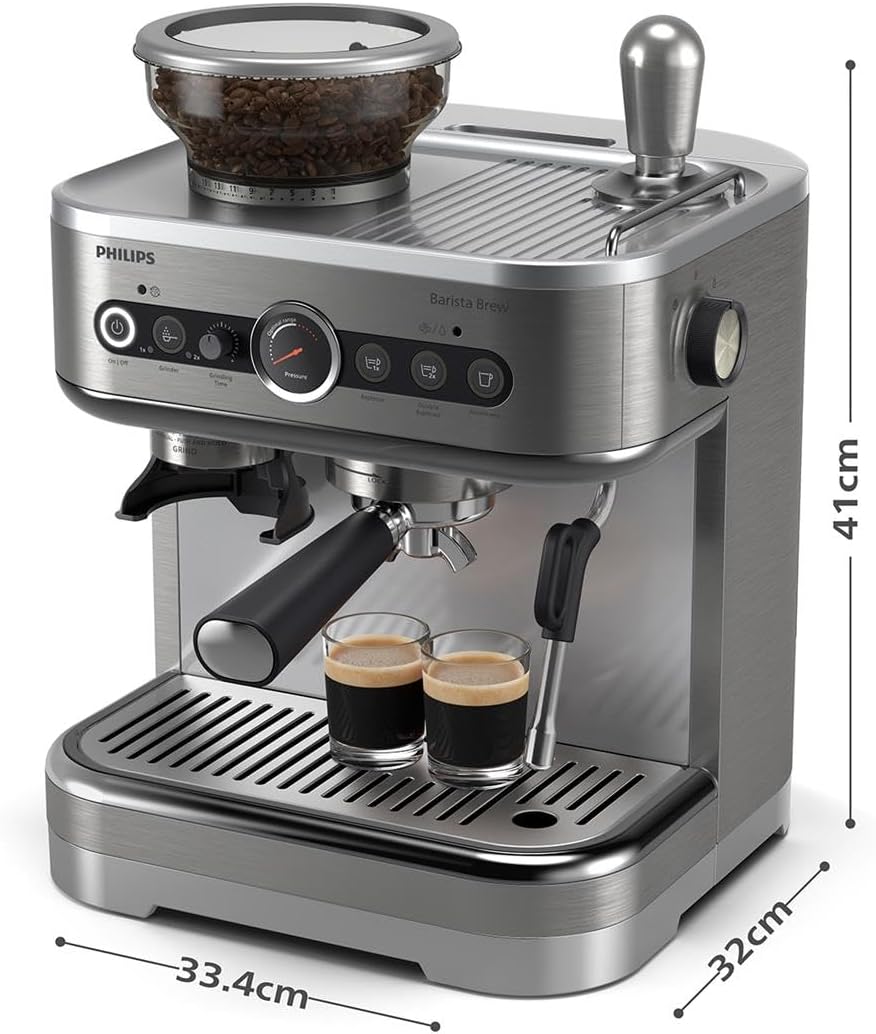


PHILIPS Barista Brew Semi Automatic Espresso Machine - Single & Double Espresso + Americano Button, 250g Bean Container, Intuitive Guidance, Calibrated Tamping, Metal Silver (PSA3218/01)
**Semi-Automatic Simplicity That Bridges Super-Automatic Convenience and Manual Control**
The espresso machine market divides sharply between fully automatic systems handling everything from grinding through milk frothing, and traditional manual machines demanding barista skills for every step. The Philips Barista Brew attempts occupying middle ground by offering semi-automatic operation with guided assistance, professional-grade accessories, and button-programmed drink options while requiring hands-on involvement in grinding, dosing, tamping, and milk steaming. This metal silver machine targets coffee enthusiasts wanting more engagement and control than super-automatics provide without the intimidating complexity and skill requirements of pure manual espresso preparation. For Canadians seeking to develop barista capabilities at home while maintaining some convenience features, or those finding fully automatic machines too limiting but manual systems too demanding, this Barista Brew represents an intriguing compromise that delivers quality through included accessories and thoughtful guidance rather than complete automation.
**Professional Tools With Semi-Automatic Guidance**
The defining characteristic separating this from Philips' fully automatic lineup is the semi-automatic approach requiring manual grinding, portafilter loading, tamping, and milk steaming while the machine handles water temperature, pressure delivery, and programmable shot volumes. This hands-on involvement creates both learning opportunities and potential frustration depending on your expectations and skill development interest.
The 58mm portafilter matches professional commercial size, ensuring compatibility with aftermarket accessories and providing the thermal mass and flow characteristics that serious espresso preparation demands. This professional standard component elevates the machine beyond toy-like smaller portafilters that compromise extraction quality.
Both single and dual wall filter baskets accommodate different skill levels and bean freshness situations. Dual wall baskets pressurize extraction, creating acceptable crema even with imperfect grinding or slightly stale beans, helping beginners achieve respectable results during the learning phase. Single wall baskets require proper grinding, dosing, and tamping technique but reward skilled preparation with superior flavor clarity and texture, providing a progression path as your abilities develop.
The integrated guidance system provides intuitive direction for crafting each cup, though reviews don't detail exactly what this guidance entails. The calibrated tamper and countertop-safe tamping system suggest structured assistance for achieving proper compression without requiring freestanding tamping stations that complicate workflow.
The 250g bean container provides storage capacity, though notably this semi-automatic machine lacks an integrated grinder unlike the fully automatic Philips models. You must purchase a separate grinder, representing significant additional investment beyond the machine itself. This omission proves critical for budget planning as quality grinders suitable for espresso cost several hundred dollars minimum.
The single, double espresso, and Americano button programming allows saving preferred shot volumes for one-touch brewing once the portafilter is loaded and locked. This automation layer simplifies the process compared to purely manual machines where you time shots manually.
The 15-bar pump delivers the 9-bar extraction pressure professional espresso requires, meeting commercial equipment standards. The high-pressure system ensures proper extraction through tightly-packed espresso grounds.
The included 450ml stainless steel milk jug with temperature control indicator provides professional-grade milk steaming capability. The powerful steam wand requires manual technique development but enables creating microfoam texture impossible with automatic frothing systems when mastered properly. However, users specifically note the steam wand proves noisy and requires practice to use effectively.
The premium accessories receive consistent praise for quality. The heavy calibrated tamper, professional-size portafilter, quality filter baskets, and temperature-sensing milk pitcher represent substantial value compared to machines bundling cheap plastic accessories requiring immediate replacement.
The anti-fingerprint metal housing creates attractive modern aesthetics while the compact footprint suits standard counter spaces. Easy-to-clean design and straightforward maintenance encourage regular use rather than discouraging operation through tedious upkeep.
**Real User Experiences Reveal Value and Learning Curves**
Users comparing this directly to popular Breville alternatives like the Bambino Plus plus separate grinder report choosing the Philips after price reductions made it compelling value. The accessory quality specifically impresses users who appreciate the heavy tamper and temperature-controlled milk pitcher rather than requiring aftermarket upgrades common with other entry semi-automatic machines.
Those transitioning from fully automatic machines acknowledge the learning curve and reduced convenience compared to push-button automation. The Philips proves not as easy to use as competing Breville models, and the milk frother specifically requires practice while producing noticeable noise. However, users accept these compromises because the accessory quality, machine construction, and price point create better overall value than alternatives at similar or higher costs.
The espresso quality receives consistent praise, with users describing great espresso when following proper techniques. The extraction consistency proves reliable once users dial in their grinding, dosing, and tamping procedures. The machine delivers rich, flavorful shots with proper crema when operated correctly.
The milk frothing capability works exceptionally well according to users who've developed proper technique, producing creamy, perfectly textured foam for cappuccinos and lattes. However, the steam wand learning curve proves steeper than automatic systems, and the noise level during steaming proves noticeable. The included temperature-sensing pitcher helps users learn proper milk steaming temperature without relying purely on hand feel.
Setup and operation benefit significantly from watching instructional videos. Users specifically recommend following setup videos and steam wand tutorials to accelerate skill development and avoid common beginner mistakes. This video research requirement represents time investment beyond simply unboxing and brewing.
The machine heats up quickly, accommodating busy morning routines without extended warm-up waits. The straightforward maintenance and easy-to-clean components encourage regular use, while the clear water reservoir prevents unexpected empty-tank interruptions mid-brewing.
However, the limited detailed reviews prevent comprehensive understanding of long-term reliability, common issues, or performance across extended use periods. The generally positive sentiment from existing users provides confidence but lacks depth covering various scenarios or durability over months and years.
The "cannot provide absolute precision" comment from one reviewer suggests limitations in temperature stability, pressure consistency, or shot-to-shot repeatability compared to higher-end semi-automatic machines. Those seeking laboratory-level extraction control should recognize this occupies entry-to-mid-level semi-automatic territory rather than precision-engineered enthusiast equipment.
**Ideal Candidates for Semi-Automatic Engagement**
This Philips Barista Brew makes excellent sense for coffee enthusiasts wanting to develop hands-on barista skills without the overwhelming complexity and expense of high-end manual systems. The guided operation and quality accessories provide supportive learning environment while requiring genuine technique development.
Those finding fully automatic machines too limiting or sterile will appreciate the engagement and control semi-automatic operation provides. The ability to adjust grinding, dosing, tamping pressure, and milk steaming technique creates customization impossible with push-button automation.
Budget-conscious buyers comparing to popular Breville alternatives should examine pricing carefully. When Philips runs sales bringing this below Breville equivalents, the accessory quality and professional-size portafilter create compelling value that justifies choosing Philips despite the brand being less established in semi-automatic espresso.
Users willing to invest time watching instructional videos and practicing technique will maximize satisfaction. The learning curve rewards effort with improving results and growing skill rather than frustrating those expecting immediate perfection.
Households where coffee preparation becomes an enjoyable morning ritual rather than rushed obligation will value the hands-on involvement. The process takes longer than super-automatics but provides engagement some users find satisfying rather than burdensome.
However, anyone wanting genuine push-button convenience should choose fully automatic machines instead. This requires manual grinding, loading, tamping, and milk steaming every single time you want coffee, representing significantly more involvement than automated alternatives.
Those without separate quality grinders must budget several hundred additional dollars for equipment essential to proper espresso preparation. The bean container proves useless without a grinder, and blade grinders or cheap burr grinders produce inadequate consistency for espresso.
Noise-sensitive households should recognize the steam wand produces noticeable sound during milk frothing. Early morning use may disturb sleeping family members more than quieter automatic milk systems.
People expecting professional-level precision should understand this occupies entry-to-mid semi-automatic territory. Temperature stability, pressure consistency, and shot-to-shot repeatability likely don't match expensive enthusiast machines.
Anyone intimidated by learning curves or lacking patience for skill development will find this frustrating. The improved results from proper technique require practice and occasional failure during the learning process.
**Critical Pre-Purchase Requirements**
Unlike fully automatic machines, this demands additional equipment investment. You absolutely need a quality burr grinder capable of espresso-fine grinding. Budget minimum several hundred dollars for adequate grinding equipment, with better grinders costing substantially more but delivering superior results.
Research and watch instructional videos before your first brew. Understanding proper grinding, dosing, distribution, tamping, and milk steaming techniques prevents wasted beans and frustration during initial attempts.
Accept the time investment both for learning and for daily operation. Each drink requires several minutes of active engagement compared to super-automatic button pressing. Morning routines must accommodate this additional time.
Understand the noise implications. The steam wand produces noticeable sound that may disturb others, particularly during early morning or late evening use.
Compare pricing carefully against Breville alternatives. When Philips runs sales, value improves dramatically. At full retail pricing, Breville alternatives may offer better overall packages depending on included accessories and features.
**Final Assessment**
The Philips Barista Brew succeeds at providing accessible entry into semi-automatic espresso through quality professional-grade accessories, guided operation, and thoughtful design at competitive pricing. The 58mm portafilter, heavy calibrated tamper, temperature-sensing milk pitcher, and dual wall filter baskets create supportive learning environment while maintaining upgrade paths as skills develop.
Real user satisfaction proves high among those accepting the semi-automatic learning curve and time investment as worthwhile trade-offs for increased control and engagement compared to super-automatic convenience. The espresso quality, milk frothing capability once mastered, and attractive design justify the investment for users wanting hands-on coffee preparation.
However, the additional grinder expense, learning curve demands, noise considerations, and daily time requirements prevent this from serving rushed households or those genuinely seeking push-button convenience. The Philips fully automatic lineup serves those users far better through genuine one-touch operation.
For Canadian coffee enthusiasts ready to develop barista skills, willing to invest in separate quality grinders, accepting practice requirements for proper milk steaming, and finding value in hands-on coffee preparation ritual, the Barista Brew delivers professional-quality tools at accessible pricing. The included accessories alone would cost hundreds purchased separately, while the guided operation prevents the complete overwhelming confusion pure manual machines create for beginners.
Just understand this occupies fundamentally different territory than super-automatic Philips models. You're trading convenience for control, automation for engagement, and push-button simplicity for hands-on craft. For those wanting that trade-off and accepting the additional equipment investment plus learning commitment, this provides excellent value that develops genuine barista capabilities while maintaining enough guidance and quality tools that success proves achievable rather than frustratingly elusive. The morning ritual becomes involved craft rather than simple button pressing, which either sounds appealing or exhausting depending on your relationship with coffee preparation.
As an Amazon Associate, we earn from qualifying purchases.